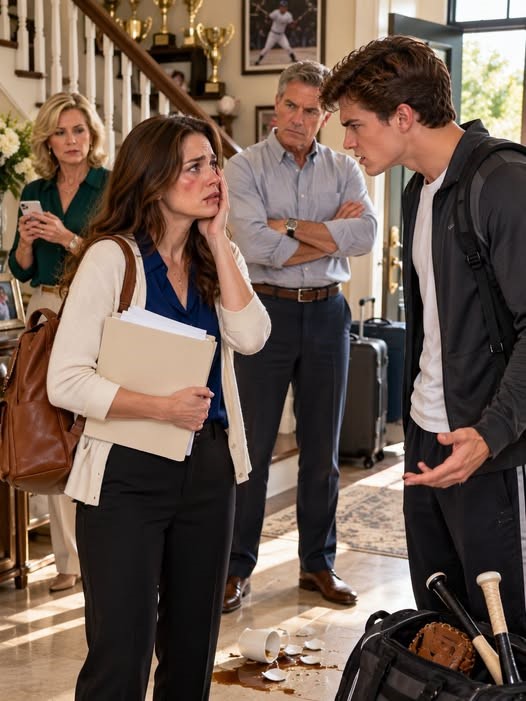

My brother said, “Cancel your doctor’s appointment and take me to my baseball game tomorrow.” When I said “no,” a sharp slap landed on my cheek, making me stumble. “Selfish brat!” — my parents added, “His future matters, your life never did.” So I walked away — and they lost everything.
My name is Victoria Beckett. I am 27 years old. I’ve lived in Denver, Colorado.
That Saturday morning, I was shaking. I was on my way to an oncology appointment. I had waited nine long, terrifying months for it. A lump under my jaw, stealing my sleep. That appointment was the only thing in my life that was just for me.
Then my little brother Dylan, the family’s golden boy, blocked the door. His baseball bags were packed.
“Cancel your doctor appointment,” he said.
His voice wasn’t a request. It was a command.
“Drive me to the airport right now.”
For the first time in my life, I told him no.
His hand cracked across my face. The slap was so loud, so hard, I staggered back, my ear screaming. I tasted blood.
I looked at my parents, desperate for them to do something.
They did nothing.
My mother didn’t even flinch. She was checking his flight details on her phone. My father just folded his arms, his face cold.
Then came the words. The words that ended our family forever.
“His future actually matters, Victoria,” my father said, his voice flat. “Yours doesn’t.”
They thought I would break. They thought I would cry and grab my keys like I always did.
They were wrong.
That was the moment I finally walked out of that house. I knew I was leaving, but they had no idea they were about to lose everything.
But before I tell you how everything flipped, like and subscribe. Drop a comment. Where are you watching from?
My name is Victoria Beckett, but for the first 26 years of my life, I was not a person. I was a ghost. I was the background noise in my brother’s life.
In our house, there was only one person: Dylan.
It started when he was 8 years old. He threw a baseball, and it went fast, faster than the other kids. My father saw it. And in that moment, my father’s eyes lit up.
He saw a future. He saw glory. He saw money.
He did not see a son. He saw an investment.
And he did not see me at all.
From that day on, our entire house changed. Everything revolved around baseball.
We didn’t have family dinners. We had refueling sessions for Dylan. The only topic of conversation was his swing, his speed, his arm.
My father, who worked in construction, took his life savings and built a batting tunnel in our backyard. It was not a small, cheap cage. It was a professional tunnel. It had thick green netting, a clay batter’s box, and stadium lights.
Those lights were brighter than the sun. They would click on at 10:00 at night, buzzing loudly, shining through my bedroom window and keeping me awake.
I would lie in bed and listen to the sounds: the whir of the pitching machine, the crack of the bat, my father’s voice over and over.
“Again, Dylan! Keep your elbow up! Again!”
My mother became his personal manager. Her entire life was a series of phone calls and appointments for him. She was always on the phone with coaches, with trainers, with travel agents.
“No, he can’t do Saturday,” I’d hear her snap into the phone. “He has a showcase. We’ll fly out Friday.”
“He needs the private lesson. I don’t care what it costs,” she’d say to my father.
Once, I asked her if she could drive me to a friend’s house.
She looked at me like I was crazy.
“Victoria, I can’t,” she said, not even looking up from her laptop, where she was booking Dylan’s flights. “I have to take Dylan to his agility training. It’s all the way across town. You’ll have to walk.”
My friend lived 6 miles away.
I walked.
While this was happening, I was trying to build a life.
I got into a local college. My parents did not pay for it.
“We’re a little tight right now, Victoria,” my dad said.
That same week, he bought Dylan a $2,000 bat.
“You understand? This is for the family.”
So, I got a job. I worked nights. I cleaned offices. I was always tired. I smelled like bleach and cheap coffee.
When I came home at 4:00 in the morning, the stadium lights in the backyard were often still on.
I would go to my room. It was in the basement. It was cold.
My old room upstairs had been turned into Dylan’s trophy room. It was filled with cheap plastic trophies and ribbons. My parents would bring guests in.
“This is Dylan’s,” they would say, their voices full of pride.
My basement room had cement walls and one bare bulb that flickered. I slept on an old cot.
The house was always full of noise: the crack of the bat, Dylan yelling, my parents praising him. But my room was quiet, except for one sound.
The batting tunnel was right above my head.
I would lie in that cold room, under my thin blanket, and I would count.
Thud. Thud. Thud.
The sound of baseballs hitting the pitching net. The sound of my brother’s future. The sound of my own invisibility.
I would count the thuds until the exhaustion finally took over.
The financial difference was the worst part.
When Dylan was 12, he flew first class to a tournament. My father took a picture of him in the big, plush seat, grinning.
“The sky is the limit, son,” my dad posted on social media.
When I was 20, my car broke down. I needed $500 to fix the engine.
“You’ll have to figure it out, Victoria,” my dad said. “You’re an adult now. You need to be responsible.”
I took the bus for 6 months.
My parents saw him as a hero. They saw me as a burden.
He was the investment. I was the expense.
He was the light. I was the shadow.
I was not their daughter. I was just the background noise.
I kept my head down. I worked. I saved every dollar I could. I cleaned those offices until my hands were raw. I studied on the bus.
I graduated college.
At 26, I finally got a real job at an advertising agency downtown. It was a small job, a junior copywriter. The pay was not great, but it was stable.
It was a desk. It was a 9-to-5. It was my lifeline.
For the first time in my life, I had a little money. I had my own money. I could buy my own groceries. I could buy new shoes.
I was still living in that cold basement room. I hated it. But I was saving money. I was making an exit plan.
I told myself, “One more year. One more year, and I can get my own apartment.”
A small, quiet apartment. No thudding. No stadium lights.
That job saved me. It gave me a place to go. A place where I was Victoria, not Dylan’s sister.
I was good at my job. My boss liked my work. I was quiet, but I was reliable.
I was almost happy.
Then I found the lump.
It was a Tuesday night. I was in the shower, the only place in the house that was truly private. I was washing my hair.
My hand moved down my neck, just under my jaw, and I felt it.
It was small. It was hard, like a frozen pea stuck deep under my skin.
My blood went cold.
I turned off the water. The silence in the bathroom was total. I felt it again.
It was definitely there.
It did not move. It was solid.
I got out of the shower. I looked in the foggy mirror. I wiped it clean. I pressed my fingers against my jaw.
I could see it. A tiny, almost invisible bump.
Panic.
Cold, sharp panic. It flooded my chest. I could not breathe.
“It’s nothing,” I told myself. “It’s a swollen gland. It’s stress.”
But I knew deep down this was not a gland.
I called my doctor the next morning. I used my lunch break. I sat in my car in the parking garage.
“It’s probably nothing,” I told the nurse. “But I found a lump.”
They got me in the next day.
Dr. Peterson was an old man. He had been my doctor since I was a child. He felt my neck. He was professional. He did not say much.
Then he frowned.
It was a small frown, just a little tightening of his lips, but I saw it.
“Hmm.”
That’s the sound you never want to hear a doctor make.
“How long has this been here, Victoria?”
“I just found it 2 days ago.”
He felt it again. He pressed harder.
“Does it hurt?”
“No.”
He sighed. He sat back on his stool. He looked at me.
“I don’t like the feel of this, Victoria,” he said. His voice was gentle. “It’s firm. It’s not moving. I’m going to send you to a specialist.”
“What kind of specialist?”
I already knew the answer.
“An oncologist.”
The word hit me like a physical blow.
“Oncology? The cancer doctor?”
I was 26 years old.
“Oh,” I said.
My voice was small.
I walked out of his office. The sky was bright. The world was too loud.
I called the oncologist’s office from my car.
“I have a referral from Dr. Peterson,” I said.
“Okay,” the receptionist said. Her voice was bored. “Our next new patient opening is in…”
I heard her clicking on a keyboard.
“9 months.”
“9 months?” I whispered. “I… I can’t wait 9 months.”
“I’m sorry, ma’am. We are booked solid. The doctors are very busy. Do you want the appointment or not?”
“Yes,” I said. “Yes, I’ll take it.”
She gave me the date. A Saturday, 9 months away.
I hung up the phone. I sat in my car for an hour.
I did not cry. I was frozen.
I had to live with this thing in my neck for 9 months. I had to live with the fear for 9 months.
I went home that night. The house was loud.
Dylan had hit a home run. My parents were celebrating. They had ordered pizza.
“Victoria, you’re late,” my mom said. She was annoyed. “We were waiting for you to bring Dylan’s protein powder.”
“I… I went to the doctor,” I said.
“Are you sick? Don’t get Dylan sick,” my dad said from the couch.
He was watching a replay of Dylan’s game.
“I found a lump in my neck. He’s sending me to an oncologist.”
My mother stopped. She looked at me.
“An oncologist? Well, don’t be so dramatic. It’s probably just an infection. You’re always stressed, Victoria. You need to relax more.”
My father did not look away from the TV.
“Whatever it is, I hope your insurance covers it. We’re putting everything into Dylan’s travel season right now.”
They did not ask if I was scared. They did not ask where the lump was.
They did not care.
The conversation was over. Dylan needed to talk about his home run.
I went down to my basement room. The thud, thud, thud from the batting tunnel started.
I sat on my cot, and for the first time, I cried.
The next day, I took a red pen. I went to the big white calendar in the kitchen.
It was filled with Dylan’s life.
Dylan, flight to Tampa.
Dylan, scout showcase.
Dylan, tryouts.
I found the date, 9 months away. I wrote in small, neat letters:
“Victoria oncology, 11:30 a.m.”
It was the only red mark on that calendar that was about me.
I looked at it every day.
That appointment became my lifeline. It was the one day, the one hour, the one moment when someone was going to look at me. Someone was going to focus on my problem.
I told myself that if I could just make it to that day, I would finally matter.
Even if it was only to a doctor.
I just had to survive the wait.
The 9 months passed. They were the longest 9 months of my life.
Every morning, I woke up, and my first thought was the lump. I would touch it.
Is it bigger? Is it the same?
The fear was a constant, cold companion.
My family did not ask about it. Not once.
My life at home got worse.
Dylan was 19 now. He was a star. He was being scouted by top colleges. He was arrogant. He was mean. My parents treated him like a king.
I was the court jester or the maid.
I kept working. I kept saving. My bank account grew slowly.
My exit plan.
I just had to get past the appointment.
Then the day arrived.
That Saturday morning, I woke up before my alarm. My stomach was a tight knot of fear.
I looked at my phone. The reminder glowed on the screen.
“Oncology 11:30 a.m. Do not reschedule.”
I took a shower. I got dressed. I put on a clean shirt.
I was shaking.
I just wanted to get my keys, get my medical records, and leave. I did not want to talk to anyone.
I went upstairs. It was 9:00 a.m.
Dylan was at the bottom of the stairs. He was wearing his travel sweatsuit. His bags were by the door.
He was furious.
“Where are my keys?” he yelled.
My mother was in the kitchen on her phone.
“I don’t know, honey. Just call an Uber.”
“An Uber? I’m not taking an Uber. I’ll be late!”
“Victoria!”
He saw me. His eyes locked on me.
“You. You’re driving me.”
I froze.
“What?”
“You heard me. I have a flight. This is the National Showcase in Miami. My flight is at 12:15. You are driving me to the airport right now.”
“Dylan, I can’t.”
My voice was a whisper.
“What do you mean, you can’t?” he spat.
“I have… I have my doctor’s appointment today. My appointment.”
I pointed to the calendar, to the red writing.
He looked at it. He laughed.
A short, ugly laugh.
“Your doctor’s appointment? Are you kidding me? This is my career. This is everything. You can reschedule a checkup.”
“It’s not a checkup, Dylan,” I said.
My voice was shaking, but I stood my ground.
“It’s the oncologist. I’ve waited 9 months for this. I am not rescheduling.”
I tried to walk past him.
He grabbed my arm.
“You don’t get it, do you? You are driving me. I don’t care about your stupid appointment.”
“No, Dylan.”
I said it clearly.
For the first time in my life, I said no to him.
“No.”
I pulled my arm away.
I saw his face change. The arrogance turned into pure rage.
“Cancel it,” he demanded.
“No.”
“I said, cancel your stupid appointment and drive me to the airport!”
“No.”
His hand moved so fast, I didn’t see it coming.
It was an open palm, full force.
The sound, a sharp crack that echoed in the hallway.
My head snapped to the side. The pain was instant, white-hot.
My vision went white. My ear was ringing, a loud, high-pitched scream.
I staggered back, hitting the wall.
My coffee mug slipped from my hand and shattered on the floor. Hot coffee splashed onto my legs.
I tasted blood. I had bitten my lip.
I touched my cheek. It was burning, stinging.
I looked up.
Dylan was just breathing hard, his fists clenched.
I looked at my mother.
She had not moved. She was still on her phone.
“Dylan, your flight boards at 12:15,” she said, her voice tight with annoyance. “You are going to be late. This is a disaster.”
She was checking his flight details.
She had seen it. She had seen him hit me, and she did not care.
I looked at my father.
He was standing in the doorway to the living room. He had been watching. He had seen it all.
He folded his arms.
“Victoria,” he said.
His voice was cold.
“Just drive your brother.”
My world stopped.
“He… He hit me,” I whispered.
My cheek was on fire. Tears were streaming down my face.
“Stop being dramatic,” my dad said. “He’s under a lot of pressure.”
Then he said the words. The words that broke the last tiny thread that held me to this family.
“His future actually matters, Victoria. Yours doesn’t.”
Yours doesn’t.
His future matters. Yours doesn’t.
The words just hung in the air.
And in that moment, the pain in my face disappeared. The fear about the lump disappeared.
All I felt was a sudden, strange, cold calm.
He was right.
To them, my future did not matter. My health did not matter. My life did not matter.
I was not a person.
I was an object, a tool to be used for Dylan’s career.
I did not say another word.
I turned around. I walked past my brother.
“Where is she going?” Dylan yelled. “Get back here!”
I walked down the stairs to my cold basement room.
My cheek was swelling. I could feel it.
I grabbed my work backpack. I put in my laptop. I put in my phone charger.
I went to my small desk. I grabbed the folder, the one with my medical records and the referral.
I grabbed the small metal box where I kept my saved cash, my exit money, and $200.
I put it all in the backpack.
I walked back up the stairs.
They were all in the hallway.
Dylan looked panicked.
“What are you doing? Give me the keys. I’m going to be late!”
My mother looked annoyed.
“Victoria, stop this. This is childish. Your brother needs you.”
My father looked angry.
“If you walk out that door, don’t bother coming back.”
I walked past them.
I went to the hook by the door. I took my car keys.
I opened the front door.
“Victoria!” my mother shrieked.
I stepped outside.
The air was cold. It felt good on my burning face.
I walked to my car. It was an old, beat-up Toyota, but it was mine.
I got in. I put the key in the ignition. I locked the doors.
Dylan ran out of the house.
He was screaming. He started banging on the driver’s side window.
“Let me in! You’re ruining everything! Let me in!”
His face was red. He was hitting the glass.
I started the car.
I looked at the house. My mother and father were standing on the porch.
My father’s face was stone.
My mother was crying, but not for me.
For Dylan.
I put the car in reverse. I backed out of the driveway.
Dylan was still screaming, running alongside the car.
I turned the wheel. I put the car in drive.
I drove away.
The slap was loud. His screaming was loud.
But the sound of me closing that door, the sound of the car driving away, that was final.
I never looked back.
I was driving. I did not know where I was going.
I was shaking so hard my teeth were chattering. Tears were streaming down my face. I could not see the road.
The pain in my cheek was a deep, dull throb.
His handprint. I could feel it.
“His future matters. Yours doesn’t.”
The words played over and over in my head.
I pulled over to the side of the road. I parked behind a grocery store.
I just sobbed.
I put my head on the steering wheel, and I cried.
Hard, ugly sobs.
For the girl who cleaned offices.
For the girl in the cold basement.
For the girl who was not seen.
For the daughter who did not matter.
After a long time, the crying stopped.
I was just empty.
I looked at the clock on my dashboard.
11:10 a.m.
My appointment.
My oncology appointment.
I still had time.
I wiped my face. I looked in the rearview mirror.
It was bad.
My cheek was swollen and purple. A perfect red handprint was starting to bloom on my skin.
I looked like a victim.
I was a victim.
I started the car. I drove to the hospital.
I walked in. I did not try to hide my face.
I went to the oncology department.
The receptionist looked up. Her eyes went wide when she saw my face.
She did not say anything.
“I’m Victoria Beckett,” I said.
My voice was hoarse.
“I have an 11:30 appointment.”
“Yes, honey. Of course. Just have a seat.”
Her voice was soft.
I sat in the waiting room. It was full of sick people. People with no hair, people in wheelchairs.
They all looked tired. They were all fighting for their lives.
And I was fighting for mine, just in a different way.
“Victoria Beckett.”
The nurse called my name. She took me back.
She weighed me. She took my blood pressure.
“Oh, honey,” she said. “Your pressure is very high.”
She looked at my face. Her eyes were kind.
“Are you in a safe place?” she asked.
I shook my head.
“No.”
“What happened to your face?”
“My brother hit me,” I said.
The words came out simple and true.
The nurse stopped writing.
She looked at me.
“Okay, the doctor will be right in. You just sit tight.”
The door opened a few minutes later.
A woman in a white lab coat walked in. She was maybe 45. She had dark hair and kind, intelligent eyes.
“Hi, Victoria. I’m Dr. Sarah Mitchell.”
She sat down on the stool. She looked at my chart.
Then she looked at me.
She really looked at me.
Her eyes went from my chart to my eyes to my swollen cheek.
Her professional smile faded.
“Victoria,” she said.
Her voice was calm and serious.
“Who did this to you?”
“My brother,” I said.
“And where are your parents?”
“They watched. They told me… They told me his future mattered and mine didn’t.”
I said it.
I said it out loud to a stranger.
And I did not cry.
Dr. Mitchell put down my chart.
She did not ask about the lump. Not yet.
She rolled her stool closer.
“Okay,” she said. “Here is what we are going to do. First, I am going to examine your neck. Then we are going to get a police report for your face. And then we are going to figure out your life, because you are not going back there.”
I just stared at her.
I started to cry again. Not the hard sobs, just quiet, tired tears.
She handed me a box of tissues.
“You are safe here,” she said.
She examined the lump. She was gentle.
“Okay,” she said. “It’s firm. It’s non-mobile. I understand why Dr. Peterson was concerned. We are going to schedule a biopsy. A fine needle aspiration. I can get you in on Monday. We are not going to wait 9 months for an answer.”
“But Victoria, where are you going to go tonight?”
“A hotel, I guess,” I said. “I have… I have some money.”
“No,” she said. “Absolutely not.”
She took out her phone. She made a call.
“Hi, it’s me. Can you cancel my one? No. No, it’s an emergency. A patient? Yes, I’ll explain later.”
She hung up.
“You’re coming home with me,” she said.
“I can’t,” I whispered. “You’re a stranger. You’re my doctor.”
“I’m a human being,” she said. “And I see a young woman who has been abused and is in danger. My guest room is empty. It’s just for tonight, until we can get you to a shelter or make a plan. Please let me help you.”
I did not have any other options.
I was too tired to argue.
I just nodded.
I followed her car.
She lived in a quiet neighborhood, a small brown house with a big garden.
It was the opposite of my house.
It was clean. It was calm. It smelled like lemon and old books.
The front door opened, and a big, fluffy golden retriever ran out.
He came right to me. He licked my hand. He pushed his head against my leg.
“This is Barnaby,” Dr. Mitchell, Sarah, said. “He believes everyone is good. He’s usually right.”
I petted the dog.
I felt a tiny bit of the ice around my heart melt.
She showed me to a guest room.
It was beautiful. It had a blue quilt and a big window.
“The bathroom is right there. There’s a new toothbrush under the sink. Towels are in the closet.”
She paused at the door.
“Victoria,” she said, “you are safe here. No one is going to hurt you.”
She gave me a spare key.
“This is yours for as long as you need it.”
That night, I took the longest, hottest shower of my life.
I washed the smell of my old house off me.
Sarah gave me a pair of clean pajamas.
We ate soup in her kitchen.
We did not talk about my family. We talked about Barnaby. We talked about her garden.
“We need to make a plan,” she said finally. “We need to lock down your finances. We don’t want them having access to your bank account.”
“It’s okay,” I said. “I only have my debit card, and I have my cash.”
“Good. Let’s get your wallet. We’ll check your credit report, just in case.”
I gave her my wallet.
It was an old, cheap thing.
She opened it.
I was sipping a cup of tea. Barnaby was sleeping at my feet.
I felt almost peaceful.
Then I saw Sarah’s face.
She was very quiet. She looked pale.
“Sarah, what’s wrong?”
She looked up from my wallet. Her face was grim.
“Victoria,” she said.
Her voice was very low.
“How many credit cards do you have?”
“Just my debit card. Why?”
She turned the wallet around.
She pulled out a card from a hidden pocket.
“A Visa.”
And another.
“A Mastercard.”
And another.
“An American Express.”
She laid them on the table.
One. Two. Three. Four.
They were hidden behind my ID, tucked into the lining.
Five. Six. Seven. Eight.
Nine credit cards.
All in my name.
Victoria Beckett.
“I… I don’t understand,” I said.
My hands were shaking again.
“I didn’t apply for these. I’ve never seen these.”
Sarah looked at me.
Her doctor eyes were back, sharp, focused.
“Victoria,” she said. “I think your brother’s future wasn’t the only thing they were worried about.”
She held up one of the cards.
“They weren’t just neglecting you. They’ve been stealing from you. They were funding his career with your life.”
The nine credit cards lay on Sarah’s kitchen table.
They were shiny, blue, silver, and gold.
They looked clean, untouched.
They looked like a lie.
“I didn’t apply for these,” I whispered.
My hands were shaking.
“I would never. I don’t even have a credit card, just my bank card.”
Sarah, Dr. Mitchell, looked at me.
Her kind doctor eyes had turned into something else.
They were sharp, focused, angry.
She was angry for me.
That was a new feeling.
“Victoria,” she said, her voice low and steady. “I promise you, you did not apply for these, but someone did. Someone with your name, your date of birth, and your Social Security number.”
My blood went cold.
“My parents. They have all of that.”
“Of course they do,” Sarah said.
She stood up.
“Get your laptop. We are not going to guess. We are going to find out right now.”
We sat at her dining room table.
Her dog Barnaby must have sensed the change in the room. He came over and put his heavy, warm head on my lap.
I gripped his fur.
“Okay,” Sarah said, pulling my laptop toward her. “We are going to pull your full credit report. All three bureaus. We need to see everything.”
I had to answer security questions.
“What was the name of your first pet?”
My mind went blank.
“I… I never had a pet. My parents said they were too expensive.”
Sarah’s jaw tightened.
“Okay, let’s try another one. What is the street you lived on in 2010?”
I answered.
I answered five more questions.
Questions about old addresses, about car loans I never had.
It was a struggle.
My identity was tangled up in things that weren’t mine.
Finally, a green check mark.
“We’re in,” Sarah said.
The page loaded.
It was not a short report. It was pages and pages and pages.
“Oh, Victoria,” Sarah whispered.
It wasn’t just the nine cards in my wallet.
There were store cards, gas cards, personal loans.
I scrolled.
My eyes could not keep up.
“Sarah, what… what is that number?”
At the top of the report, there was a box.
Total debt: $178,000.
I said it. My voice did not sound like my own. It was a high, thin whisper.
“No, that’s a mistake. That’s… That can’t be real.”
“It’s real,” Sarah said.
She was already clicking, opening the accounts, opening the statements.
“Let’s look at the charges, Victoria. Let’s see what $178,000 buys.”
She opened the first card.
An American Express Platinum. $50,000 limit.
The statement was full.
“Look at this,” she said, pointing. “American Airlines, $2,800, March 12th. Does that date mean anything to you?”
March.
That was Dylan’s showcase in Florida.
“My dad… My dad bragged that he flew first class.”
“He did,” Sarah said. “On your credit.”
Marriott Tampa, $900.
Hyatt Phoenix, $4,100.
“Another one,” I said, pointing. “Elite athlete supplements, $2,500. What is that?”
“Steroids,” Sarah said, her voice flat. “That’s what that is. Banned substances.”
My stomach twisted.
We clicked on another card. A Visa Signature.
BSN Sports, $4,000. January.
“What? What is BSN Sports?”
“Let’s check,” Sarah said.
She opened a new tab. She typed it in.
“They sell sporting equipment,” she said. “High-end radar guns, pitching machines, batting cages.”
“My father built a new batting cage in January,” I whispered. “He said he got a construction bonus. He said it was for the family’s future.”
“He was right,” Sarah said. “It was for his future. And he paid for it with your future.”
It was all there.
Every trip, every hotel, every new piece of equipment.
They didn’t just pay for his things.
They paid for their things.
Steakhouse dinners for $400.
A new TV from Best Buy.
I read, “$3,000.”
My dad bought that for the living room to watch Dylan’s games better.
“They were living like kings,” Sarah said. “On your name.”
My mind started to race.
“How?” I asked. “How did I not know? The mail. The bills. I never saw a single bill.”
“Where did you live, Victoria?”
“In the house. In the basement,” I said.
“And who got the mail?”
“My mother. She always got the mail.”
I remembered.
I remembered asking, “Is there any mail for me?”
“No, honey, just junk. I threw it out,” she would say.
She wasn’t throwing out junk mail.
She was hiding the statements.
She was hiding the evidence.
They had my Social Security number. They had my address. They had my entire life.
They stole my identity.
I thought back.
I remembered trying to get a cell phone plan 2 years ago.
The man at the store looked at me with pity.
“I’m sorry, ma’am. Your credit is… It’s just too low. You’ve been declined.”
I was so embarrassed.
I thought it was because I had no credit.
I didn’t realize it was because I had the worst credit.
I thought it was because I was poor.
I didn’t realize it was because I had been robbed.
My parents knew. They watched me get declined.
They probably laughed about it.
I thought about my car, the one that broke down. The $500 I needed to fix it.
$500.
“Victoria, we’re a little tight right now.”
My father had said that same month.
This report showed he spent $1,200 on a new pitching radar gun.
They watched me take the bus for 6 months.
They watched me count pennies for groceries.
They watched me work overnight cleaning toilets to pay for college.
All while they were charging thousands of dollars a month to my name.
Sarah’s voice cut through the fog.
“Victoria, look at me.”
I looked up.
My eyes were burning, but I was not crying.
“They didn’t just hurt you this morning,” she said.
Her voice was pure steel.
“They didn’t just hit you. They have been stealing your life for years. This is not neglect. This is a crime. A long-planned criminal conspiracy against you.”
The slap on my face.
The $178,000 in debt.
It was the same thing.
It was all about control.
It was all about showing me that I did not matter.
My father’s words came back.
“His future matters. Yours doesn’t.”
This is what he meant.
My future was just a credit line for them to use up.
I was a resource, a ghost they could pin their debts on.
That night, the crying stopped.
The girl who cried in the basement was gone.
The girl who was afraid of the oncologist was gone.
The grief I felt, the sadness, it didn’t just go away.
It burned.
It burned away all the fear, all the doubt.
And it left something hard and cold in its place.
It left absolute, total clarity.
I looked at the number on the screen.
$178,000.
I was not afraid of it. I was not sad.
I was not a victim anymore.
I was a woman with a file.
I was a woman with evidence.
And I was done.
The next two weeks were a blur.
I lived at Sarah’s house.
I was a ghost, but a different kind.
I slept in her quiet guest room. I played with Barnaby. I went to work at the ad agency, my bruised face hidden behind my hair, and a story about walking into a door.
My boss was kind. He did not ask questions.
Sarah was my rock.
She was my doctor, my lawyer, and my friend.
We went to the police.
I filed a report about the assault. I filed a report about the identity theft.
The officer looked at my swollen face. He looked at the stack of credit card statements.
He shook his head.
“This is one of the worst family cases I’ve ever seen,” he said.
We went to the hospital on Monday, just as she promised.
Dr. Mitchell, Sarah, did the biopsy.
A long, thin needle.
I did not flinch.
“You’re brave,” she said.
“I’m just focused,” I said.
She told me the results would be back in a week or two.
For the first time, I was not afraid of the answer.
The lump in my neck was nothing. It was small.
The real sickness, the real cancer, was my family.
And I was already cutting it out.
I blocked their numbers.
My phone, which had been buzzing with their frantic, angry calls, went silent.
“Where are you? You get back here right now!”
“Dylan missed his flight, you stupid girl! You ruined everything!”
I blocked my father.
I blocked my mother.
I blocked Dylan.
The silence was wonderful.
It was the first true peace I had ever known.
I was in this strange, quiet bubble.
I was waiting.
Waiting for the biopsy results.
Waiting for the police.
Waiting for the credit card companies.
The world was moving on.
And then, 2 weeks after the day I left, the world caught up with Dylan.
I found out, like everyone else, on the internet.
I was at work on my lunch break.
I was just scrolling through a local news website, and I saw his picture.
His high school graduation photo, the one where he was smiling, wearing his baseball cap.
The headline was sharp.
“Local baseball phenom Dylan Beckett fails drug test at national showcase.”
My heart stopped.
I clicked the article.
My hands were shaking.
“Dylan Beckett, 19, a top recruit, has been disqualified after testing positive for three separate banned substances.”
It named them.
Anabolic steroids, human growth hormone, and a chemical masking agent.
The same thing Sarah and I had seen on the credit card statements.
The elite athlete supplements for $2,500.
He hadn’t just been using them.
He had been caught.
The article was brutal.
“Beckett’s actions are a shock to the local community.”
It said he was seen as a golden boy, a future star.
A scout was quoted.
“His name is mud. He’s finished. No college will touch him now. He didn’t just cheat. He used a cocktail. He’s a fraud.”
A fraud.
Just like our parents.
The fall was not slow.
It was instant.
It was like a switch had been flipped.
For 20 years, the name Beckett meant perfect family. It meant glory.
Overnight, the Beckett name became a scandal.
The dominoes fell one by one.
I watched it happen from the safety of Sarah’s house.
First, the leaderboards.
His name, which had been at the top of every list, was just gone, replaced by the word “disqualified.”
Then the coaches.
The head coach of the college that had offered him a full scholarship, the one my parents had bragged about, put out a statement.
“We are officially withdrawing our scholarship offer for Mr. Beckett. We have a zero-tolerance policy for these substances.”
They ghosted him.
His phone must have been blowing up, but not with praise.
With rejection.
Recruiters who had been calling my mother all day, they vanished.
And then the hate.
The people who had loved him, the parents who had held him up as an example, they turned.
The comments on the articles were horrible.
“Junkie.”
“Cheater.”
“He should be in jail.”
“What kind of parents raise a kid like this?”
I didn’t feel happy. I didn’t feel sad.
I just watched.
I was a spectator.
This was not my family anymore.
This was a news story.
Then my phone started to buzz.
It was a new number, and another, and another.
They were finding ways to reach me.
They were using their friends’ phones.
My mother was first.
The texts were not texts.
They were long, screaming blocks of words.
“What did you do? You did this! You told them! You ruined your brother’s life! He was under pressure. You were always jealous! Always! You ungrateful, hateful child! You are no daughter of mine!”
I read it.
I blocked the number.
My father was next.
A voicemail from a blocked ID.
His voice was not yelling. It was cold.
It was terrifying.
“Victoria, you pick up this phone. I don’t know what you told those people. I don’t know what lies you’ve been spreading, but you are going to fix this. You are going to call that reporter, and you are going to tell them you made it all up. You hear me? You are going to fix what you broke, or I will.”
A threat.
I saved the voicemail.
I emailed it to the police officer, and I blocked the number.
Then Dylan.
His text came from a friend’s phone.
It was just what the outline of my life said it would be.
First, he begged.
“Torri, please. I’m sorry. I’m sorry I hit you. I was stressed. You know the pressure. Please, you have to help me. Tell them it was a mistake. Tell them it was yours. I don’t know. Just please. You’re the only one who can fix this. I’ll pay you back. I promise.”
I looked at the text.
“I’ll pay you back.”
The laugh that came out of me was short and ugly.
With what money?
With what future?
He had nothing.
I did not respond.
I just looked at the screen.
5 minutes passed.
A new text came from the same number.
The begging was gone.
The real Dylan was back.
“Fine. Be that way. This is your fault. You did this to me. You were always jealous. You were always trying to ruin my life because you didn’t have one. My life is over, and it’s all because of you. I hate you. I hate you.”
I read the words.
“My life is over.”
I looked at the text.
I did not respond.
I did not get angry. I did not get sad.
I just held down my finger on the number.
A menu popped up.
I pressed “Block Contact.”
The messages stopped.
The phone in my hand went quiet.
The house was quiet.
I was not a victim.
I was not a sister.
I was just a witness.
And the show was finally over.
The 30 days after Dylan’s fall were the quietest days of my life.
My phone was silent. The flood of hate had stopped.
They had no more numbers to borrow, no more ways to reach me.
But the silence was not passive.
It was not empty.
It was busy.
I was not just healing.
I was building.
I was building a case.
Sarah and I worked every single night.
Her kitchen table was our war room.
We had the binder.
It was a thick, black three-ring binder, and we filled it.
We printed every credit card statement, page after page.
We got three different colors of highlighters.
Yellow was for Dylan’s baseball expenses.
Pink was for my parents’ personal luxuries.
Orange was for charges we could not identify.
The binder grew heavy.
We did not just collect the statements.
We matched them.
We became detectives.
I went online.
I found Dylan’s old high school fan page.
His entire travel schedule for the last 3 years was on it.
My mother had posted it. She was so proud.
“Look,” I said to Sarah, my voice flat.
I pointed to the computer screen.
“August 4th, Desert Classic Showcase, Phoenix.”
Then I pointed to the yellow-highlighted line on the credit card statement.
“August 4th, Hyatt Regency, Phoenix, $750. August 4th, American Airlines, $200. August 4th, Capitol Grill, Phoenix, $412.”
“A perfect match,” Sarah said.
We did this for every single trip.
Florida, Texas, California.
We proved line by line that I had paid for his entire career.
Then the steroid invoices.
https www\.google.com.
Searchq eliteesups.com.
We printed those.
We matched the dates to his offseason training.
Then the forgery.
This was Sarah’s idea.
“We need to find the original applications,” she said.
We went online.
We requested the records from the credit card companies using the police report I had filed.
They came in the mail one by one to Sarah’s safe address.
And there it was.
My name, Victoria Beckett, in my mother’s handwriting.
That neat, perfect cursive script she used for birthday cards.
She had signed my name over and over again.
She had forged my signature to steal my life.
I remembered years ago she had helped me fill out my college financial aid forms.
“Oh, your handwriting is so messy, Victoria,” she’d said. “Let me do it. Just give me your information.”
She hadn’t just helped me.
She had been practicing.
She had been stealing my Social Security number, my history, my future.
We put those forged applications in the front of the binder.
After 30 days of this quiet, meticulous work, the binder was full.
It was 6 inches thick.
It was a detailed record of their lies.
It was my life story written in debt.
I did not feel anger when I looked at it.
I felt ready.
I took a day off from work.
I put on my best clothes. A simple black dress.
I walked into the best law office in Denver.
I did not have an appointment.
The receptionist looked at me.
“Can I help you?”
“I need to speak to a lawyer,” I said. “A partner. Someone who specializes in high-value federal fraud.”
She raised an eyebrow.
I did not look like someone who talked about federal fraud.
“Ma’am, you will need to make an appointment.”
“Please,” I said.
And I lifted the binder.
It was heavy.
I placed it on her desk with a solid, heavy thud.
“Just give this to your boss. My name and number are on the front. I will wait.”
I sat down in the lobby.
I waited.
10 minutes later, a man in a sharp suit came out.
He was holding my binder.
His face was serious.
“Miss Beckett,” he said. “Please come with me.”
His name was Mr. Harrison.
His office was on the top floor. It looked out over the whole city.
He had not offered me coffee. He had not smiled.
He opened the binder.
He was silent for a full 5 minutes.
He just turned the pages.
He saw the forged signatures.
He saw the matching flight receipts and Facebook posts.
He saw the steroid invoices.
He saw the $178,000.
Finally, he looked up.
“Miss Beckett,” he said. “This is meticulous. This is one of the most complete cases of identity theft I have ever seen.”
“So, you’ll take the case?” I asked.
He shook his head.
“This is not a case I can take. This is not a civil suit. Well, it is, but it’s so much more. This is federal. This is bank fraud. This is wire fraud. The people who did this, they didn’t just steal from you. They stole from the banks. They lied on federal applications. This is the IRS. This is the FBI.”
He leaned forward.
“I can make some calls,” he said. “I can hand this binder over to the U.S. Attorney’s Office, to the FBI’s white-collar crime division. But you need to understand what you are doing. If I make that call, this is out of your hands. You are starting a fire you cannot put out.”
“They are my family,” I said.
“I know,” he said. “That’s why I’m warning you.”
I thought about my cold basement room.
I thought about the sound of the slap.
I thought about my mother’s handwriting on that forged application.
“His future matters. Yours doesn’t.”
I looked at Mr. Harrison.
“They started the fire,” I said. “They just thought I would be the one who burned.”
“Make the calls.”
I walked out of his office.
I felt lighter.
The heavy binder was gone.
It was not my burden anymore.
It was 10 days.
That’s all it took.
I was at work. I was sitting in a meeting about a new ad campaign.
My phone vibrated.
It was a news alert from a local TV station.
I opened it, and I saw their faces.
My father, my mother, my brother.
Not on a baseball field. Not on a proud family vacation.
It was their mugshots.
My father looked old. His eyes were dead.
My mother looked confused. Her perfect hair was a mess.
Dylan looked terrified. He was crying.
The headline was simple.
“Local baseball family arrested in major fraud steroid ring.”
The story was all there.
John, Mary, and Dylan Beckett were arrested in a multi-year fraud scheme.
Authorities say they stole the identity of their own daughter to fund their son’s failing baseball career and a lavish lifestyle.
The case also involves a connection to an ongoing steroid investigation.
The FBI and the IRS are both involved.
This is a federal case.
I looked at the mugshot.
The same faces they once paraded around as the perfect family.
The same faces that had looked at me with coldness and dismissal.
Now they were a headline.
Now they were a scandal.
Now the whole world knew what they had done.
My boss was talking.
“Victoria, are you okay?”
I looked up from my phone.
I had to take a slow, deep breath.
“Yes,” I said. “I’m fine.”
14 months.
That’s how long it takes for the federal government to grind.
14 months of my new life.
I had moved out of Sarah’s house.
I was in my own apartment, a small one-bedroom place.
It was clean. It was quiet.
I went to work. I paid my own bills.
I went to therapy. Sarah had insisted.
“You’ve survived the war,” she said. “Now you have to learn how to live in the peace.”
I had spent those 14 months talking to lawyers.
I was the government’s star witness.
I had to tell my story over and over to the FBI, to the IRS, to the U.S. Attorney.
They looked at my binder.
They looked at me.
“You’ve made our job easy, Miss Beckett,” the attorney said.
There was no trial.
My evidence, my binder, it was too much.
They had no defense.
My father, my mother, and my brother, they all pleaded guilty.
The 14 months were just a slow march to this one single day.
The sentencing.
I woke up that morning.
I did not feel sick.
I did not feel scared.
I felt calm.
I thought about what to wear.
What do you wear to the end of your family?
I did not wear black.
That was for mourning.
I was done mourning.
I wore a simple blue dress. I wore the new shoes I had bought with my own paycheck.
Sarah asked if I wanted her to come.
“No,” I said. “This is the one last thing I have to do by myself.”
I drove to the federal courthouse in Denver.
It was a huge stone building.
It was made to make you feel small.
I did not feel small.
I walked through the metal detector.
I found the courtroom.
I opened the heavy wooden door, and I saw them.
It was the first time I had seen them in person in 14 months.
My father was in an orange jumpsuit.
He had lost weight. His hair was gray.
He looked like an old, broken man.
My mother was sitting behind him.
She was wearing a cheap-looking suit. She was twisting a tissue in her hands.
Dylan was next to her.
He was pale. He had gained weight.
His golden boy shine was gone.
He was just a soft, scared-looking man.
The courtroom was almost empty.
All the fans, all the other parents, all the community supporters, they were gone.
The media was gone.
It was old news.
It was just them, their lawyers, and me.
I sat in the back on the prosecution side, alone.
I was not a part of their family.
I was the witness against them.
The judge entered.
We all stood.
We all sat.
The sound of the courtroom was heavy.
The air was thick.
The lawyers talked.
“Mitigating circumstances,” my father’s lawyer said. “A father’s misguided love.”
“A lifetime of devotion to her family,” my mother’s lawyer pleaded. “She was controlled by her husband.”
“He was a young man under incredible pressure,” Dylan’s lawyer said.
Lies.
They were still lying.
They were lying to a federal judge.
The judge, a sharp-eyed woman, was not impressed.
“I have read the victim impact statement,” the judge said.
My statement.
I had not yelled. I had not cried.
I had just written the facts.
The basement.
The slap.
The $178,000.
“This was not a mistake,” the judge said.
Her voice cut through the room.
“This was a conspiracy. A cold, calculated, multi-year campaign of abuse and theft against your own daughter. You did not just steal her money. You stole her identity. You stole her security. You stole her youth.”
The judge looked at my father.
“John Beckett. You were the leader of this. You abused your power as a father. You are sentenced to 8 years in federal prison.”
The gavel fell.
Crack.
It was so loud.
My father did not move.
He just deflated.
8 years.
The judge looked at my mother.
“Mary Beckett, you were the one who forged the signatures. You were the one who hid the mail. You were the enabler and the co-conspirator. You get 5 years’ probation. You will pay restitution. You will not see a credit card for the rest of your life.”
My mother started to cry.
A loud, ugly sob.
Not for me.
For herself.
The judge looked at Dylan.
“Dylan Beckett. You are the golden boy this was all for. You were an adult. You knew what was happening. You took the steroids. You enjoyed the plane tickets. You are sentenced to 2 years’ probation.”
I almost felt a flash of anger.
2 years?
That was nothing.
But the judge wasn’t finished.
And she said, “You are hereby issued a lifetime ban from all professional, collegiate, and organized amateur sports. Your career is over.”
Dylan put his head in his hands.
That, for him, was the real prison.
The dream was dead.
The judge looked at me in the back row.
“Miss Beckett,” she said, “the court is aware of your suffering, and the court is sorry for what you have been through. This case is closed.”
The gavel fell.
Crack.
Justice.
Silence.
In that moment, as the marshals were cuffing my father, my mother turned her head.
Her eyes, red and swollen, scanned the room, and they found me.
Her eyes locked on mine.
They were full of what?
Hate, pleading, blame.
All of it.
The old me, the girl in the basement, would have looked away.
She would have flinched.
I did not flinch.
I did not blink.
I just looked at her.
I held her gaze.
There was nothing left to say.
I had won.
I broke the stare.
I stood up, and I walked out of the courtroom.
I pushed open the heavy doors.
I walked into the bright, cold sunshine.
It was over.
I was free.
The first phone call I got after the sentencing was not from a reporter.
It was from Dr. Mitchell’s office.
It was the call I had been waiting for.
“Victoria, we have the final results from your biopsy.”
I had almost forgotten.
The lump.
The thing that started it all.
The fear I felt that Saturday morning.
It seemed like a lifetime ago.
“Yes,” I said.
I was standing in my new, sunny kitchen.
“It’s benign, honey,” the nurse said. “Just a swollen lymph node. Nothing to worry about at all.”
I hung up the phone.
Benign.
A harmless word.
The thing in my neck, the lump that I thought was cancer, it was nothing.
It was just a symptom.
The real cancer had been in my house.
The real cancer was the stadium lights, the trophy room, the lies.
The real sickness was my family.
And I had cut it out.
I touched my neck.
The lump was gone.
I was healthy.
The next year, I built a life.
It was not a big, loud, shiny life.
It was not a life that anyone would put on a leaderboard.
It was just mine.
I worked at my job. I was good at it. I got a promotion.
The court ordered my parents’ house to be sold.
The money, what was left of it, went to the banks to pay for the fraud.
The debt was no longer tied to my name.
My credit, which had been in the 300s, was now clean.
I saved my money.
And one day, I did something I had only dreamed of.
I bought a house.
It was not a big house.
It was a small green bungalow in Boulder.
It had a porch.
It had a small garden.
It had sunlight.
It was a quiet house.
There were no batting cages.
There were no stadium lights.
There were no trophies.
The only noise was the sound of my coffee maker in the morning and the sound of Barnaby.
Sarah had given him to me.
“You two saved each other,” she said. “He needs a full-time mom.”
He was now snoring at my feet.
My life was simple, and it was mine.
A year passed.
I was driving home from work.
I took a different turn.
I don’t know why.
Maybe I was just ready.
I found myself in my old neighborhood.
I found myself on my old street.
I pulled up across from the house.
My old house.
It looked different.
It was not a shrine.
It was not a baseball stadium.
It was just a house.
The new owners had painted it.
It was a nice, friendly yellow.
There were flowers in the front yard.
And the batting tunnel, it was gone.
The giant professional $10,000 cage was gone.
The stadium lights were gone.
The pitching mound, the clay square my father had built like a religious altar, it was gone.
It was just grass.
Green grass.
As I sat there, the front door opened.
A young family came out.
A man, a woman, and a little girl.
The little girl was maybe 5 years old.
She was holding a plastic wand.
The father started blowing bubbles.
The little girl shrieked with laughter.
She ran across the lawn.
She was chasing bubbles, a blur of pink and blonde hair.
She was running and jumping and dancing right on the spot where Dylan’s pitching mound used to be.
Right on the sacred ground that had cost my family everything.
The land was healed.
A little girl was just being a little girl.
I watched her, and I smiled.
It was not a sad smile.
It was not an angry smile.
It was just a smile.
They had lost everything.
My father was in a cell.
My mother was in a court-mandated job.
Dylan was living in a halfway house, banned from the only thing he ever knew.
They lost the house.
They lost the glory.
They lost the lie.
They lost it all, chasing a future that was never real.
I had lost it all, too.
But I had gained something so much better.
I gained peace.
I gained my name back.
I gained a life that is finally and completely mine.
I put the car in drive.
I drove away from the yellow house.
And I never, ever looked back.
The End