
My husband’s parents gave each of their other three children $20,000 to help buy a home. All we received was a card telling us how capable we were. I thanked them anyway. Two springs later, we bought the old Miller property at a courthouse auction for $41,500.
The envelopes had been placed beneath the Easter dinner plates.
Kim opened hers first and put a hand over her mouth.
Jeff opened his next.
Then Stacy, who began crying into her napkin.
Each of them had received twenty thousand dollars to put toward a house.
Our envelope held a card with a bluebird on the cover.
“You two have always been so capable,” Judy had written. “We never worry about you.”
There was nothing more inside.
I looked through the envelope twice.
Nate read the message, then tucked the card into his shirt pocket.
His ears went red, as they always did.
Ron lifted his coffee cup toward us.
“That’s the truth. It’s a compliment.”
“Thank you,” I said. “It’s a beautiful card.”
I could have asked why we were treated differently.
But you can’t demand a gift from someone, especially when his mother had been up cooking since five that morning.
Nate never spoke badly about his parents.
Once we were in the truck, all he asked was, “How much do we have saved?”
“Six thousand two hundred.”
“Then we’ll need another job,” he said. “I’ll pick up harvest calls.”
“I’ll work at the diner,” I replied.
During the week, I worked in insurance billing at the hospital.
On Friday nights, Saturday nights, and Sunday mornings, I waited tables at the truck stop.
Nate worked on combines after dark, taking cash for the repairs.
He sold his bass boat.
We ate eggs more often than I could count.
And we told no one.
It would have sounded as though we were asking for help.
Two springs later, the county listed the old Miller property for auction because of unpaid taxes.
Nobody had lived there for six years.
The porch was sinking. The weeds stood waist-high.
Nate made one trip around the house.
“Good bones,” he said.
The auctioneer was a man named Dobbs, standing at the top of the courthouse steps.
A landlord in a quilted vest drove the bidding to $41,000.
We couldn’t go above $42,000.
“Forty-one five,” Nate called.
The landlord shook his head.
“Sold,” Dobbs announced.
I handed over a cashier’s check along with $1,500 I had saved in tips.
The clerk counted the money two times.
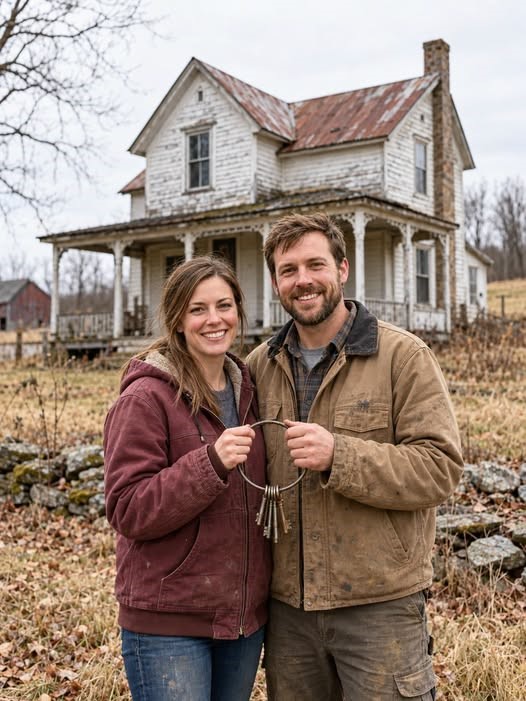
Then she passed us a ring of worn keys.
We still didn’t tell anybody.
After finishing his regular shift, Nate spent his nights replacing the house’s wiring, working through one room at a time.
I peeled away old wallpaper until the skin on my thumbs cracked.
But the property sale was published in the legal notices.
And Nate’s grandmother never misses a line of the newspaper.
Opal was eighty-eight years old.
She called me while I was working.
“Pick me up Sunday after church,” she said. “And don’t tell Ronald.”
I drove her six miles along the county road.
She remained silent the entire way.
When we reached the porch, she wouldn’t let me help her.
She stepped directly into the front room.
It was as though she already knew the way to the kitchen.
She stopped beneath the lone exposed light bulb.
Then she laid her palm against the pantry doorframe.
And tears began rolling down her face without a sound.
In all eleven years I’d known her, I’d never once seen her cry.
“Opal,” I asked. “What’s wrong?”
She traced her thumb over the aged wood, almost as if she were trying to find something.
“Emily,” she said. “Has no one ever told you who this house belonged to?”
Opal turned toward me slowly.
Her eyes were wet, but her voice was steady.
“My husband built this house.”
For a moment, I thought I had misunderstood her.
“Your husband?”
“My first husband,” she said. “Walter Miller. Before I married Ronald’s father.”
I looked around the room.
The cracked plaster. The exposed wiring Nate had carefully stapled along the studs. The yellowed linoleum curling away from the kitchen floor.
“Miller,” I whispered.
Opal nodded.
“That’s why they called it the Miller place.”
I had known Opal for eleven years. She had attended our wedding, sent us anniversary cards, and never forgotten a birthday. I’d heard stories about her childhood, her garden, and the years she’d worked at the grain elevator.
But I had never heard her mention Walter.
She lowered herself into the only chair we had brought into the house.
“He died when I was twenty-six,” she said. “We’d been married seven years. He was a good man. Quiet, just like your Nate.”
I sat on an overturned paint bucket beside her.
“Why didn’t anyone tell us?”
“Because Ronald doesn’t like talking about things he can’t put a price on.”
She looked toward the kitchen.
“Walter and I were going to raise our children here. We planned every room together. That pantry doorframe was the last thing he finished before the accident.”
Her voice faltered.
I waited.
“After he died, I couldn’t keep the farm. I was young, and I didn’t have enough money to carry the mortgage. The bank sold it. I married again four years later.”
She rubbed her hands together.
“I used to drive past every Christmas. Then I stopped. It hurt too much.”
I glanced at the worn wood beneath her palm.
“Did you know it was going up for auction?”
“I knew the taxes were behind. Didn’t know how far. By the time I heard about the sale, I figured one of the landlords would get it.”
“And then you saw our names.”
She smiled through her tears.
“Imagine that. Out of everyone in this county, the two people who never ask for anything bought the house I’d spent sixty years wishing I could walk through again.”
I looked down at my hands.
There were still strips of wallpaper adhesive stuck beneath my fingernails.
“We didn’t know, Opal.”
“I know you didn’t, sweetheart.”
She reached over and squeezed my wrist.
“That’s what makes it something special.”
For a while, neither of us spoke.
The afternoon sunlight fell across the unfinished floor, illuminating the scratches in the old boards.
Then Opal leaned forward.
“Now, there’s something else you need to know.”
I felt my stomach tighten.
“Ronald knows this house.”
“How?”
“Because I brought him here when he was sixteen. I showed him where Walter and I had planned to put a nursery. I told him what this place meant to me.”
She hesitated.
“And two months before that Easter dinner, I asked him to help me find out whether the property could be bought.”
I stared at her.
“Ron knew it might be for sale?”
“He knew I wanted it back in the family. He told me the county situation was too complicated and the place wasn’t worth saving.”
Opal’s mouth tightened.
“I believed him.”
Outside, a pickup rolled down the gravel road.
I recognized the sound before it reached the driveway.
Nate.
He had come straight from work, still wearing his stained mechanic’s jacket.
He climbed out carrying a cardboard box of electrical supplies.
When he saw his grandmother through the open doorway, he stopped.
“Grandma?”
Opal stood so quickly I reached out to steady her.
“My goodness,” she said. “Look at you.”
Nate set the box down.
“Mom said you weren’t feeling well after church.”
“I felt fine until I realized your father had been keeping things from me.”
Nate glanced at me.
I shook my head slightly.
“Your grandma has something to tell you.”
Opal crossed the room and took both his hands.
Then she told him everything.
About Walter.
About their first seven years together.
About the mortgage, the bank sale, and the dream she had carried for more than six decades.
Nate listened without interrupting.
When she finished, he looked toward the pantry doorframe.
“So this was your house?”
“My first home,” Opal answered.
He swallowed.
Then he said something that made both of us cry.
“Well, Grandma, it looks like you came home.”
Opal covered her mouth.
Nate put his arms around her.
And for the first time since we’d purchased the property, I felt something besides exhaustion.
I felt as though we’d found something we hadn’t even known was missing.
But the discovery came with a question I couldn’t ignore.
Why had Ron discouraged his own mother from trying to reclaim a house that meant so much to her?
And why had he never mentioned it to us?
We found out sooner than I expected.
The following Wednesday, Judy called Nate during supper.
I was standing at the stove, stirring a pot of beans, when his phone rang.
He answered on speaker because his hands were covered in drywall dust.
“Hey, Mom.”
“Your grandmother has been telling everyone you bought the Miller property.”
Nate glanced at me.
“We did.”
“Well, why on earth didn’t you tell us?”
“We hadn’t gotten around to it.”
Judy made a small sound of disapproval.
“Your father is very upset.”
Nate leaned against the counter.
“About what?”
“He says you paid too much for a condemned farmhouse.”
“It isn’t condemned.”
“That’s not what he heard.”
“Then he heard wrong.”
There was a pause.
Judy lowered her voice.
“Your father says you should have discussed a purchase that size with him first.”
Nate looked at the ceiling.
“Mom, I’m thirty-six years old.”
“You know what I mean.”
“No, actually, I don’t.”
I had never heard him speak to her that way.
Judy seemed equally surprised.
“Well, don’t take that tone. Your father is trying to protect you.”
“From buying a house?”
“From making a terrible financial mistake.”
Nate rubbed his forehead.
“We paid cash. We know what repairs it needs. And we’re doing the work ourselves.”
Silence.
Then Judy asked, “You paid cash?”
“Yes.”
“All forty-one thousand?”
“Forty-one five.”
Another silence.
I could almost hear her calculating.
Finally, she said, “Well, I suppose that’s wonderful.”
But she didn’t sound pleased.
And before hanging up, she added something that stayed with me.
“Your father wishes you had waited. There were other plans for that property.”
Nate straightened.
“What plans?”
“Never mind. We’ll discuss it on Sunday.”
Then she hung up.
Nate stood staring at his phone.
I turned off the burner.
“Did you know about any plans?”
“No.”
“Do you think your dad was trying to buy it?”
Nate considered that.
“Dad hasn’t bought property in twenty years.”
“Then what plans was she talking about?”
He set his phone down.
“I guess we’re going to find out.”
We didn’t have to wait until Sunday.
Ron appeared at the farmhouse the next morning.
I was scraping paint from the upstairs window trim when I heard a truck door slam.
Through the glass, I saw his silver Ford parked beside Nate’s work truck.
Ron stood in the yard with his hands on his hips, staring up at the roof.
I went downstairs.
“Morning, Ron.”
He didn’t smile.
“Where’s Nathan?”
“At work.”
“He leave you here alone?”
“I have a car.”
Ron looked past me into the house.
“You really bought this dump?”
I wiped my hands on a rag.
“Yes.”
“Forty-one thousand five hundred dollars?”
“That’s right.”
He shook his head.
“You could’ve put that toward a perfectly good starter home.”
“We wanted this one.”
“You wanted a rotting farmhouse with a bad roof and no central heat?”
I didn’t answer.
Ron walked onto the porch.
The boards creaked beneath his boots.
“You don’t understand what you’ve gotten into.”
“We had an inspection of the structure before bidding. Nate knows electrical work. We have a contractor helping with the foundation.”
He waved that away.
“That’s not the point.”
“Then what is?”
He looked toward the gravel road.
For the first time, he seemed uncertain.
Finally, he said, “The property was supposed to go to someone else.”
My stomach dropped.
“Who?”
He didn’t answer immediately.
Then he said, “Jeff.”
I stared at him.
“Jeff?”
“Your brother-in-law.”
“I know who Jeff is.”
Ron shifted his weight.
“He was planning to expand his rental business. That land would have been useful.”
I looked around the property.
The maple trees.
The neglected pasture.
The farmhouse Opal had once called home.
“You wanted Jeff to buy it?”
“He was looking into it.”
“Did he bid?”
“No.”
“Then he wasn’t ready to buy it.”
Ron frowned.
“That’s not how these things work.”
“It’s exactly how a courthouse auction works.”
His face darkened.
“Emily, watch your tone.”
I put the scraper down.
“Ron, we bought this place legally. We’ve already started repairs. What exactly are you asking us to do?”
He stared at me.
Then he said, “I’m asking you to be reasonable.”
“About what?”
“Jeff could pay you what you spent, plus a little extra. You’d walk away without losing anything.”
I couldn’t believe what I was hearing.
“We’re not selling.”
“You haven’t even lived here yet.”
“We will.”
“Your husband should be part of this discussion.”
“He is. We’ve already decided.”
Ron crossed his arms.
“Does he know you’re making decisions like this without consulting him?”
That did it.
I took one step forward.
“Nate and I spent two years saving for this house. We worked nights and weekends. He sold his boat. I waited tables until my feet swelled. Every single dollar we put into this property came from us.”
Ron’s expression changed.
I continued.
“You gave your other children twenty thousand dollars each to help them buy homes. That was your choice, and we respected it. But you don’t get to tell us what to do with the house we bought ourselves.”
He looked away.
“That money has nothing to do with this.”
“Then neither do you.”
For several seconds, the only sound was the wind moving through the dead grass.
Ron stepped backward.
“You’ll regret speaking to me that way.”
I picked up my scraper.
“Maybe. But I won’t regret buying this house.”
He left without another word.
I stood at the doorway until his truck disappeared.
Then I went inside, sat on the kitchen floor, and cried.
Not because I was frightened.
Because I finally understood something I’d been trying not to admit for years.
Ron and Judy didn’t consider us capable because they admired our independence.
They considered us capable because it gave them permission to overlook us.
And as long as we remained quiet about it, they could pretend the arrangement was fair.
When Nate came home, I told him everything.
He listened with that same expression he’d worn at Easter.
Except this time, his ears didn’t turn red.
His face went completely still.
“Dad said Jeff was supposed to get it?”
“Yes.”
“And he offered to buy us out?”
“Yes.”
Nate set his lunch cooler on the table.
Then he reached for his phone.
“Who are you calling?”
“Jeff.”
I waited while the call connected.
Jeff answered on the fourth ring.
“Hey, little brother.”
“Did you know Dad was planning to buy the Miller place for you?”
A pause.
“What?”
“The farm we bought. Dad says it was supposed to go to you.”
Jeff laughed awkwardly.
“Man, I don’t know what he’s talking about.”
“Are you trying to buy it from us?”
“No.”
Nate looked at me.
“Dad came here today and told Emily you’d pay us back if we handed it over.”
Jeff stopped laughing.
“Wait. He did what?”
Nate repeated the offer.
Jeff swore under his breath.
Then he said, “Nate, I looked at that property last winter. I decided against it. The repairs were too much for me to take on.”
“Dad knew?”
“Yeah. I told him.”
Nate gripped the phone tighter.
“Then why would he say it was meant for you?”
Jeff hesitated.
“I think you need to talk to Mom.”
Nate’s expression hardened.
“Why?”
Another pause.
“Because she was furious when she heard Grandma wanted that place back.”
I felt cold.
“Why would Mom care?” Nate asked.
Jeff sighed.
“Because Grandma asked Dad to help her buy it, and Mom said it would be a waste of money. They argued about it for weeks.”
Nate looked at me.
“Did Mom tell you why?”
“Something about Grandma being too old to make financial decisions. I wasn’t paying much attention.”
He stopped.
Then he added, “Nate, there’s something else.”
“What?”
“Dad told us at Easter that you and Emily didn’t want any help buying a house.”
I felt my breath catch.
Nate closed his eyes.
“He said what?”
“He told us you were saving up and wanted to do everything yourselves. Said you wouldn’t accept money even if he offered.”
For a moment, nobody spoke.
Then Nate asked, very quietly, “Did he tell you that before or after you got your checks?”
“Before.”
Nate thanked him and ended the call.
We stood in the kitchen facing each other.
I remembered Judy’s handwriting.
You two have always been so capable.
We never worry about you.
I remembered the bluebird on the front of the card.
And I remembered how carefully Nate had slipped it into his pocket.
He walked into the bedroom, opened the top drawer of our dresser, and returned with the envelope.
He had kept it for two years.
He laid it on the table.
“I thought maybe we’d been too proud,” he said.
I stared at him.
“What?”
“After Easter. I thought maybe we should have asked them for help before they gave the others money.”
“Nate, we didn’t even know they were planning to give anyone anything.”
“I know.”
He looked at the card.
“I just kept wondering if I’d done something wrong.”
I reached across the table.
“You didn’t.”
He nodded.
But his eyes were wet.
That evening, he called Opal.
He didn’t tell her what Ron had said about the house.
He simply asked whether she could come over for supper on Sunday.
“And bring Dad and Mom?” she asked.
Nate glanced at me.
“Yes,” he said. “Bring everyone.”
I raised my eyebrows.
He covered the phone.
“I’m tired of finding out what my own family thinks through somebody else.”
For the first time in eleven years, I didn’t try to talk him out of a confrontation.
I just nodded.
Sunday arrived with a cold wind and a sky the color of dishwater.
I spent the morning cleaning the farmhouse as well as I could.
There was no point pretending it was finished.
The downstairs bathroom had a new sink but no mirror. Half the kitchen cabinets were missing their doors. Sheets of drywall leaned against the dining room wall.
Nate borrowed folding chairs from a neighbor.
I made a pot of chili and two pans of cornbread.
At eleven thirty, Opal arrived carrying an apple pie.
At eleven forty-five, Kim and Stacy pulled into the yard.
Jeff came next.
Ron and Judy arrived last.
Judy stepped out of the truck wearing a cream-colored coat and carrying her usual covered casserole.
She stopped when she saw the house.
“Well,” she said. “It certainly needs work.”
Opal stood on the porch beside me.
“So did I when I turned eighty,” she replied. “Didn’t mean I was ready to be thrown away.”
Kim laughed.
Judy didn’t.
We ate in the front room, seated around a folding table Nate had covered with a clean sheet.
At first, conversation stayed safely on ordinary things.
The weather.
Stacy’s children.
Jeff’s rental properties.
Kim’s new job.
Nobody mentioned the house.
Then Opal put down her spoon.
“Ronald, I have a question.”
Ron looked up.
“What is it, Mother?”
“Why did you tell me this property couldn’t be purchased?”
His spoon stopped halfway to his mouth.
“Because it wasn’t a sensible investment.”
“That wasn’t my question.”
Judy cleared her throat.
“Opal, I really don’t think this is the time.”
“I’m eighty-eight years old, Judith. I think I’ll decide when it’s time to ask about my own memories.”
The room fell silent.
Opal turned back to Ron.
“I asked you to look into buying the Miller place. You told me it was too complicated. Then I learned it went to auction, and Nathan and Emily bought it without knowing a thing about its history.”
Ron set down his spoon.
“The house was in terrible shape.”
“Yes,” Opal said. “But that’s not what you told me.”
“I was trying to protect you.”
“From what?”
“From spending your retirement savings on a money pit.”
Opal folded her hands.
“Then you should have told me that was your concern. You should have brought me the information and let me decide.”
Ron looked toward the window.
I could see the muscles working in his jaw.
Then Nate spoke.
“Dad, did you really tell everybody Emily and I didn’t want help buying a house?”
Ron turned toward him.
“What?”
“At Easter. Jeff said you told them we wouldn’t accept money.”
Judy stiffened.
“That was a private family discussion.”
Nate looked at her.
“Apparently, Emily and I were the only family members who weren’t included.”
Kim put her fork down.
“Wait. You didn’t know about the checks?”
“We knew when everyone opened them,” I said.
“No,” Kim answered. “I mean, you didn’t know Mom and Dad were giving us house money?”
Nate shook his head.
Jeff leaned back.
“I told you, Dad. That wasn’t right.”
Ron looked irritated.
“You don’t understand the situation.”
“Then explain it,” Nate said.
Ron glanced at Judy.
She stared at her untouched chili.
Finally, Ron sighed.
“Your mother and I had sixty thousand set aside to help the children get established.”
I felt Nate go rigid beside me.
“Sixty thousand,” he repeated.
Ron nodded.
“Twenty thousand for each household that needed it.”
“There were four households,” Stacy said quietly.
Judy answered before Ron could.
“Nathan and Emily have always handled their finances differently.”
I looked at her.
“How?”
She hesitated.
“You save. You don’t have credit card debt. You’ve never asked us to cover a mortgage payment or repair a car.”
“So because we didn’t need rescuing, we didn’t deserve the same help?” I asked.
Judy’s face flushed.
“Emily, that’s an unfair way to put it.”
“Then help me understand.”
She looked at Ron.
He took a breath.
“We made a judgment about where the money would do the most good.”
Nate stared at his father.
“And you couldn’t tell us?”
“We knew you were proud of managing things yourselves.”
“You decided that for us.”
Ron frowned.
“Nathan, you make it sound as though we punished you.”
Nate reached into his shirt pocket.
He pulled out the bluebird card.
I’d seen him place it there before we left home.
He laid it on the table.
“You told us we were capable,” he said. “And I spent two years believing that meant you respected us.”
Judy looked at the card.
“I meant every word.”
“Then why did you tell Jeff we wouldn’t take the money?”
She didn’t answer.
Nate waited.
Finally, she said, “Because it would have been embarrassing to tell everyone we’d decided you didn’t need it.”
There it was.
No grand conspiracy.
No hidden trust fund.
Just a decision made behind our backs, followed by a lie intended to make the decision easier to defend.
Kim covered her mouth.
Stacy looked at her mother as though she were seeing her for the first time.
Jeff shook his head.
“Mom, that’s awful.”
Judy’s eyes filled.
“We did what we thought was best.”
Opal spoke softly.
“No, Judith. You did what was easiest.”
Nobody answered.
Then Ron pushed back his chair.
“I’ve had about enough of this. We gave away our own money. We had every right.”
Nate nodded.
“Yes, Dad. You did.”
Ron seemed surprised.
Nate continued.
“You had every right to give the others twenty thousand dollars. You had every right to give us nothing.”
His voice remained steady.
“But you didn’t have the right to lie about what we wanted. And you certainly don’t have the right to come onto our property and demand that we sell it to Jeff.”
Jeff sat upright.
“Excuse me?”
Ron looked toward him.
“That’s not what happened.”
I stared at Ron.
“You offered to have Jeff buy us out.”
Jeff turned toward his father.
“Dad, I already told you I don’t want this property.”
Ron waved a hand.
“I was trying to arrange a solution.”
“To what problem?” Jeff asked.
Ron said nothing.
Opal leaned forward.
“Ronald, were you trying to keep me from owning this place?”
His expression shifted.
“No, Mother.”
“Were you?”
Ron looked around the table.
Then he sighed.
“I thought if Jeff bought it, we could keep the land in the family without you pouring your savings into it.”
“But Jeff didn’t want it,” Opal said.
“He could’ve changed his mind.”
“And Nathan does want it. Nathan and Emily bought it with their own money. Why isn’t that good enough?”
Ron had no answer.
Opal watched him for a long moment.
Then she said, “I think I understand.”
I looked at her.
She turned toward Nate.
“You’ve always been the child who could manage without anyone.”
Nate lowered his eyes.
“Grandma—”
“No, let me finish.”
She placed her wrinkled hand over his.
“When you were little, you fixed your own bicycle. Your brother would come crying when his chain fell off, and your father would go running to help him. But you sat in the driveway until you figured yours out.”
Nate smiled faintly.
“I remember that bike.”
“I do too. And I remember telling Ronald he ought to go out and help you.”
She looked at her son.
“You said the boy needed to learn.”
Ron studied the tabletop.
Opal’s voice softened.
“Somehow, along the way, you stopped noticing that the boy who learned to manage was still your son.”
Judy began crying.
Not loudly.
Just quiet tears falling onto her napkin.
I didn’t feel triumphant.
I felt tired.
Because a part of me had spent years hoping that someday the family would recognize how hard we worked.
And now, sitting in a half-renovated farmhouse, I realized recognition wasn’t something we could earn by sacrificing enough.
Nate stood.
“I need some air.”
I started to follow him, but Opal shook her head.
“Give him a minute.”
Through the window, I watched my husband walk to the old stone wall at the edge of the yard.
He rested his hands on it and looked across the fields.
Ron remained seated.
After several minutes, Jeff got up.
He went outside and joined his brother.
They stood talking for a while.
Then Jeff put a hand on Nate’s shoulder.
It was such a small thing.
But I knew how much it meant.
Back inside, Judy finally looked at me.
“Emily, I am sorry.”
I waited.
She wiped her face.
“I don’t think I realized how much that card hurt you.”
“The card wasn’t the worst part,” I said.
She looked puzzled.
I chose my words carefully.
“We worked ourselves almost sick trying to save for a home. And we did it without telling you because we didn’t want anyone thinking we were asking for money.”
Judy’s eyes dropped.
“Meanwhile, you were telling people we had refused help that was never offered.”
“I know.”
“We thought we had to be quiet to keep our dignity.”
My throat tightened.
“But being quiet made it easier for you to ignore us.”
Judy pressed the napkin against her mouth.
“I don’t know how to fix that.”
“Neither do I,” I said.
And for once, I didn’t rush to make her feel better.
After lunch, Ron went outside to speak with Nate.
I couldn’t hear the beginning of their conversation.
Then Nate came back through the doorway and asked me to join them.
Ron stood beside his truck.
His face was pale.
“Your husband tells me you won’t consider selling under any circumstances.”
“We won’t,” I said.
He nodded.
“I understand.”
Nate crossed his arms.
“Do you?”
Ron looked toward the house.
“I suppose I’ve been thinking about it the wrong way.”
Neither of us answered.
He continued.
“When Mother talked about buying it, I kept seeing bills and repairs. I couldn’t understand why she’d want to put money into something that old.”
He glanced at Nate.
“And when I heard you two bought it, I thought you’d acted without knowing what you were doing.”
“We knew exactly what we were buying,” Nate said.
Ron nodded again.
“I see that now.”
Then he reached into his jacket.
He pulled out his checkbook.
“I can give you the twenty thousand we should’ve given you.”
For a second, my heart actually lifted.
Not because I needed the money.
But because I thought he was finally trying to treat Nate equally.
Then Ron added, “At least it’ll help you get out from under this place if the repairs get too expensive.”
Nate’s expression closed.
He looked at the checkbook.
Then at his father.
“No.”
Ron frowned.
“Nathan, don’t be stubborn.”
“I’m not being stubborn.”
“Twenty thousand dollars would make a substantial difference.”
“Two years ago, it would have.”
Ron hesitated.
Nate continued.
“But you don’t get to offer it now because you’re afraid we’ll fail.”
“That’s not why I’m offering.”
“Then why?”
Ron opened his mouth.
Nothing came out.
Nate took a breath.
“Dad, I’m not refusing because I don’t want your help. I’m refusing because I need you to understand something first.”
He gestured toward the house.
“This isn’t some mistake we’re waiting for you to rescue us from. It’s our home.”
Ron looked down.
“And I don’t want Emily thinking every board we replace belongs partly to someone who can threaten to take it away.”
I stood beside my husband.
Ron slowly closed his checkbook.
“Then what do you want from me?”
Nate thought for a moment.
“I want you to apologize to Emily for coming here and speaking to her the way you did.”
Ron’s eyes moved to mine.
He looked uncomfortable.
Then he nodded.
“Emily, I was out of line. I had no business suggesting you were making decisions behind Nathan’s back.”
“Thank you,” I said.
“And I shouldn’t have threatened you.”
“No,” I agreed. “You shouldn’t have.”
He took that without arguing.
Then Nate said, “And I want you to tell Grandma the truth about why you discouraged her from looking into this place.”
Ron looked toward the porch, where Opal was standing with Judy.
“I believe she already knows.”
“She deserves to hear it from you.”
Ron stood quietly for several seconds.
Then he walked back toward the house.
I didn’t know whether anything would come of that afternoon.
An apology couldn’t erase eleven years of being overlooked.
And twenty thousand dollars offered too late couldn’t give us back the weekends we’d spent working while everyone else was enjoying their new homes.
But as Ron climbed the porch steps, I felt something loosen inside me.
For the first time, we’d told the truth without apologizing for it.
The next few weeks were quieter.
Judy called twice.
The first time, she asked whether we needed anything.
I told her we were fine.
The second time, she asked whether she and Ron could come help clean up the yard.
I told her I’d ask Nate.
He thought about it overnight.
Then he said yes.
They arrived the following Saturday wearing work clothes.
Ron brought a chainsaw.
Judy brought sandwiches.
Neither offered advice we hadn’t requested.
That alone felt unusual.
Ron helped Nate remove two fallen trees near the barn.
Judy spent three hours hauling broken branches into piles.
At lunch, she sat beside me on the porch steps.
“Emily,” she said, “I owe you another apology.”
I looked at her.
“I’ve been thinking about Easter.”
I didn’t speak.
She picked at the paper around her sandwich.
“I told myself the money would make the biggest difference to the children who were struggling. But I never asked what you and Nathan needed.”
She paused.
“And I think part of me liked having one child I didn’t have to worry about.”
I looked across the yard.
Nate was helping Ron load branches onto a trailer.
“Being responsible doesn’t mean you stop needing your parents,” I said.
Judy nodded.
“I know that now.”
“It’s not really about the money.”
“I understand.”
She sat quietly.
Then she said, “I hope you’ll let us show you we’re trying to do better.”
I didn’t promise her everything would return to normal.
I simply said, “You can start by treating Nate the same way you treat everyone else.”
She nodded.
And we went back to work.
A month later, Opal came to the house carrying a small wooden box.
She asked Nate and me to sit down.
Inside were photographs.
Black-and-white pictures with curled edges.
There was a young woman in a cotton dress standing beside a man in overalls.
Behind them stood the farmhouse.
Its paint was fresh.
The porch columns were straight.
Flowers bloomed beneath the front windows.
“That was Walter,” Opal said.
Nate picked up a photograph.
“He looks like Grandpa Henry.”
Opal smiled.
“No, sweetheart. Henry never had that much hair.”
We laughed.
She showed us the original kitchen, the garden, and a picture of Walter standing beside the pantry doorframe.
Then she handed me a folded piece of paper.
It was yellowed and fragile.
“What is it?” I asked.
“Something I found among my old letters.”
I unfolded it carefully.
It was a pencil sketch of the house.
On the back, written in a man’s neat handwriting, were four words.
For our future family.
I looked up.
Opal’s eyes were shining.
“Walter drew that before we moved in.”
She reached into the box and lifted out another photograph.
It showed the pantry doorframe before the house had been painted.
Near the bottom was a small carving.
Two initials.
W and O.
With a heart between them.
I stood immediately.
“Come with me.”
We went into the kitchen.
The frame was still exposed because I hadn’t gotten around to sanding it.
I crouched beside it.
Near the bottom, beneath sixty years of paint, I found a faint indentation.
Nate knelt next to me.
He rubbed the edge of the wood gently.
Then he smiled.
“Grandma.”
Opal lowered herself into a chair.
“What?”
Nate pointed.
“They’re still here.”
Her hand flew to her mouth.
I watched my husband take a small piece of fine sandpaper from his tool belt.
He worked carefully, removing just enough loose paint to reveal the marks.
W + O.
A little crooked heart.
And underneath, almost invisible, the year Walter had finished building the house.
Opal began crying again.
Nate stopped sanding.
“Grandma?”
She shook her head.
“I’m all right.”
Then she laughed through her tears.
“I was just remembering how angry I got when he carved that. I told him he was ruining perfectly good wood.”
Nate sat back on his heels.
“Guess he knew it would last.”
Opal covered the carving with her hand.
For a long time, she didn’t move.
That summer, the house began changing faster.
Nate finished the wiring.
The foundation contractor completed the porch supports.
I painted the bedrooms and restored the old kitchen cabinets instead of replacing them.
Jeff showed up one Saturday with a borrowed trailer and helped haul out the rotten flooring.
Kim brought curtains she’d sewn herself.
Stacy arrived with her children and a basket of tomato plants.
And Ron came every other weekend.
He never mentioned selling again.
He and Nate still disagreed about plenty of things.
But they learned to discuss repairs without turning every conversation into a contest over who knew best.
One afternoon, I found them standing beside the pantry.
Ron was studying the little carving in the wood.
“You know,” he said, “I remember Mother showing me that when I was a kid.”
Nate looked at him.
“Then why didn’t you tell me this was her house?”
Ron rubbed the back of his neck.
“I hadn’t thought about it in years.”
He paused.
“That’s not a very good answer, is it?”
“No,” Nate said.
Ron nodded.
“I guess it isn’t.”
Then he added, “Your grandma has been happier these past few months than I’ve seen her in a long time.”
Nate glanced toward the window, where Opal was sitting beneath the maple tree.
“She belongs here,” he said.
Ron looked at him.
“So do you.”
Nate didn’t answer immediately.
Then he said, “Thanks, Dad.”
I watched from the kitchen doorway.
It wasn’t a perfect reconciliation.
But it was a beginning.
By September, we’d saved enough to install a proper heating system.
The upstairs bedrooms had fresh paint.
The bathroom had a working shower.
And the porch no longer dipped toward the yard.
We moved our furniture in on a Saturday.
Most of it was secondhand.
Our dining table had a scratch across one corner.
The couch had belonged to my aunt.
Our bedroom dresser was the same one we’d used in our first apartment.
None of it mattered.
That night, Nate and I sat on the porch with two cups of coffee.
The sky was clear.
Crickets sang in the grass.
Somewhere beyond the fields, a dog barked.
Nate leaned back in his chair.
“Remember that Easter?”
I smiled faintly.
“Which part?”
“The bluebird card.”
“Hard to forget.”
He stared across the yard.
“I thought I’d never stop being angry about it.”
“Are you?”
“Sometimes.”
I nodded.
“Me too.”
He looked at me.
“But I wouldn’t trade this house for twenty thousand dollars.”
I rested my head against his shoulder.
“Neither would I.”
He slipped his arm around me.
Then he said, “You know what Grandma told me yesterday?”
“What?”
“She said Walter used to sit on this porch after work and talk about all the things he was going to fix next.”
I laughed.
“Sounds familiar.”
“Apparently, he never finished his list.”
“Neither will you.”
Nate grinned.
“Probably not.”
A week before Thanksgiving, Opal asked whether she could have dinner at our house.
She wanted the entire family there.
I worried about the space.
We still didn’t have enough chairs.
But Opal insisted.
“It’s a farmhouse, Emily. People have been squeezing into farmhouses for a hundred years.”
So we borrowed chairs again.
Judy made the turkey.
Kim brought potatoes.
Stacy made pies.
Jeff brought drinks.
And I put a blue tablecloth over our scratched dining table.
When everyone arrived, Opal asked us to gather in the front room.
She was wearing a pale blue dress and holding the wooden box of photographs.
“I have something I want to say,” she announced.
Everyone settled down.
She looked around the house.
At the fresh walls.
The restored floors.
The windows Nate had repaired.
Then she looked at me.
“Sixty years ago, I lost this home.”
Her voice trembled.
“I thought I would never see it filled with my family again.”
She turned toward Nate.
“And then these two went and bought it without even knowing what it was.”
A few people smiled.
Opal continued.
“I used to believe losing this house meant losing the life Walter and I had planned.”
She touched the old wooden box.
“But I understand something now.”
She looked at her son.
“Sometimes, things come back to us in ways we could never have arranged ourselves.”
Ron lowered his head.
Opal held out the box.
“Nathan, Emily, I want you to have these pictures.”
I accepted it carefully.
“Opal, are you sure?”
“They belong here.”
Then she reached into her purse and took out a small envelope.
My heart gave a strange little jump.
For one terrible second, I thought of Easter.
Opal noticed my expression.
She smiled.
“Don’t worry, sweetheart. No bluebirds.”
Everyone laughed.
Inside the envelope was a handwritten note.
I unfolded it.
It read:
To Nathan and Emily,
You didn’t know what this house meant to me when you bought it.
You only knew it needed someone willing to work.
You gave it your time, your savings, and your strength.
And without knowing it, you gave an old woman back a piece of her life.
I cannot repay you for that.
But I can tell you something I should have told your family a long time ago.
Being capable does not mean you deserve less love.
It means the people who love you should be proud to stand beside you, even when you don’t need them to stand in front of you.
Thank you for bringing me home.
Love, Grandma Opal.
I couldn’t finish reading aloud.
Nate took the paper from my shaking hands.
He read the final lines.
When he finished, nobody spoke.
Then Judy rose from her chair.
She came around the table and embraced her son.
“I am proud of you,” she whispered.
Nate held her for a moment.
“I know, Mom.”
She pulled back.
“No. I don’t think you did.”
He looked at her.
She brushed a tear from her cheek.
“But I want to make sure you do from now on.”
Across the room, Ron stood near the mantel.
He looked uncomfortable, the way he always did when emotions lasted longer than a handshake.
Then he walked over.
He put one hand on Nate’s shoulder and the other on mine.
“You two did a fine job,” he said.
Nate smiled.
“Thanks, Dad.”
Ron looked around the room.
“Walter would’ve liked what you’ve done with it.”
Opal nodded.
“Yes,” she said. “He would have.”
We ate dinner crowded around the table.
Children argued over the last dinner roll.
Jeff spilled gravy on the tablecloth.
Stacy’s youngest fell asleep on the couch.
Kim insisted on taking a family photograph.
And for the first time in years, I didn’t feel as though Nate and I were standing outside the circle, expected to clap politely while everyone else was celebrated.
We were simply part of the family.
Not because we’d become more successful.
Not because we’d finally proved we deserved something.
But because we’d stopped accepting silence as the price of belonging.
After dinner, when everyone had gone home, I found Nate standing in the kitchen.
He was looking at the little carving in the pantry doorframe.
“Thinking about Walter?” I asked.
“A little.”
He slipped his arm around my waist.
“Mostly thinking about how close we came to missing this place.”
I leaned against him.
“We almost stopped bidding at forty-one thousand.”
He smiled.
“Good thing you had those tips.”
“Good thing you sold that boat.”
He groaned.
“I knew you’d bring that up.”
I laughed.
Then he kissed my forehead.
We stood there beneath the kitchen light, in a house that still needed repairs, surrounded by dishes we hadn’t washed and chairs we’d have to return the next morning.
It wasn’t the kind of home anyone would have chosen from a real estate brochure.
But it was ours.
The following spring, exactly one year after we’d received the keys, Opal helped me plant bluebirds’ favorite flowers along the front walk.
We put in coneflowers, black-eyed Susans, and a row of native berry shrubs.
She supervised from a lawn chair while I worked.
When Nate came home, he had something in his truck.
A small wooden sign.
He’d made it himself.
The lettering was simple.
THE MILLER HOUSE
Below it, in smaller letters, he’d carved:
HOME AGAIN.
We hung it beside the front door.
Opal stared at the sign for a long moment.
Then she reached for Nate’s hand.
“Walter would have loved you,” she said.
Nate swallowed.
“I wish I could’ve met him.”
She squeezed his fingers.
“In a way, I think you have.”
That evening, I opened the old dresser drawer where Nate had kept the bluebird card.
I took it out and read the message one last time.
You two have always been so capable. We never worry about you.
For two years, those words had felt like an explanation for why we deserved less.
Now they reminded me of something different.
We had worked hard.
We had sacrificed.
We had made mistakes, fixed them, and kept going.
We had built a home with our own hands.
And we’d learned that independence was something to be proud of, but it should never have been used as an excuse to withhold kindness.
I placed the card inside the wooden box with Walter’s photographs and Opal’s letter.
Not because the hurt had disappeared.
But because it was part of how we’d arrived here.
Then I closed the box and carried it into the kitchen.
Nate was standing at the window, watching Opal admire the flowers.
He looked over his shoulder.
“Everything okay?”
I nodded.
“Everything’s good.”
Outside, a bluebird landed on the porch railing.
Opal pointed at it, delighted.
Nate laughed.
And I thought about the Easter when everyone else opened envelopes containing twenty thousand dollars.
We’d received a card.
Two springs later, we’d paid $41,500 for an old farmhouse nobody wanted.
What we’d found inside was worth more to us than we’d ever known to ask for.
Not because the house was valuable.
Not because we’d won some contest against Nate’s parents.
But because those worn floorboards had given an eighty-eight-year-old woman a way back to the happiest memories of her youth, and they’d given us a place to build our own.
For years, we’d believed we had to do everything alone.
Now, when the porch needed fixing, someone showed up with a hammer.
When the garden needed planting, someone arrived with seedlings.
And when we gathered around our table, there was room for everyone who wanted to be there with love and respect.
We never did get that original twenty thousand dollars.
Eventually, that stopped mattering.
Because the greatest thing we gained wasn’t an inheritance, a check, or even a house.
It was the understanding that we could be strong without being forgotten.
And every time I walked through our front door and saw Nate’s wooden sign, I remembered Opal’s words.
Being capable does not mean you deserve less love.
Underneath the old roof Walter Miller had built, we finally learned to believe her.
THE END.