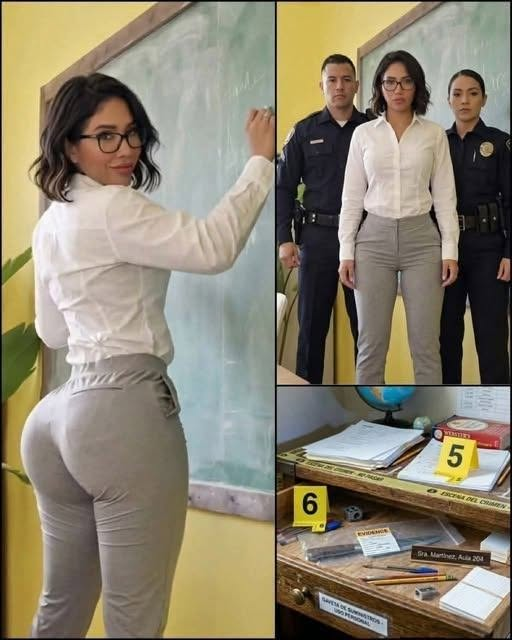

Santa Rosa, Colombia — News that took hundreds of residents of the Santa Rosa community by surprise began circulating after authorities confirmed an investigation in which a 29-year-old woman, identified as Daniela Marcela Vargas, was summoned to answer questions in a case that had been under investigation for several weeks.
The viral image, composed of three panels showing a teacher, police officers, and an evidence table, is an artificially generated or digitally staged narrative, rather than an actual photograph of the crime scene. AI-generated images and digitally staged photo series often combine familiar archetypes—such as educators, police officers, and crime scene markers—to construct fictional storylines designed for social media engagement. In the left panel, a woman wearing glasses, a white shirt, and gray pants stands in front of a whiteboard. The top right panel shows the same woman alongside two uniformed police officers in an identification pose, while the bottom right panel shows a wooden table with evidence markers, documents, and an evidence bag containing a knife. Digital image generation algorithms often produce synthetic scenes with soft lighting, characteristic facial symmetry, and slightly distorted text or background details, which are common indicators of AI-generated or heavily edited content. Online creators regularly post continuous photo series with consistent characters involved in fictional storylines to attract viewers, generate comments, and increase their social media following. The staging of a crime in digital storytelling often relies on recognizable visual elements, such as numbered yellow markers for evidence, official-looking badges, and name tags on desks, to convey a sense of drama and journalistic realism. Fact-checking groups and digital media researchers emphasize the importance of analyzing lighting consistency, hand proportions, and contextual details to distinguish between synthetic content and authentic journalistic photography. Digital literacy tools, such as reverse image search and forensic software analysis, help users verify the origin of viral image sets. The proliferation of hyper-realistic image generation tools allows creators to rapidly produce complex visual narratives without needing to film on real locations or witness real-world events. Understanding the mechanics of synthetic image generation helps the public critically analyze online media and avoid mistaking staged or artistic compositions for genuine journalistic reports. Visual storytelling on digital platforms continues to blur the line between entertainment and reality, making critical evaluation an essential skill for today’s internet users. Ultimately, this multi-panel graphic serves as an example of staged or AI-generated digital content designed for viral entertainment, rather than documenting an actual police investigation.